
 Orthopedic Rehabilitation
 Balance & Vestibular Therapy
 Hand & Upper Extremity Therapy
 Workers’ Comp & Auto Injuries
Every September, on the first day of fall, the National Council on Aging leads Falls Prevention Awareness Week. This year it runs September 21–25, and it exists because of a number worth sitting with: one in four adults over 65 falls each year, and falls remain the leading cause of injury in that age group.
Here’s the part we want our neighbors to hear. A fall is not an inevitable consequence of getting older. Balance is a skill, and like any skill, it can be trained, strengthened, and restored.
Don’t Avoid Your Balance Issues
Most balance problems don’t get better by avoiding them. When someone becomes afraid of falling, the natural response is to move less, hold the handrail tighter, stop walking on grass, stop going out after dark. Every one of those adjustments is understandable and every one of them makes the underlying problem worse. Muscles weaken. Reaction time slows. The world gets smaller.
Real improvement requires the opposite. To retrain balance, a patient has to be brought right to the edge of their stability to the point where they would actually lose it and then practice recovering. That’s where the nervous system learns.
The obvious question is:
How do you balance safely with someone who is already afraid?
Our answer: the overhead safety support system
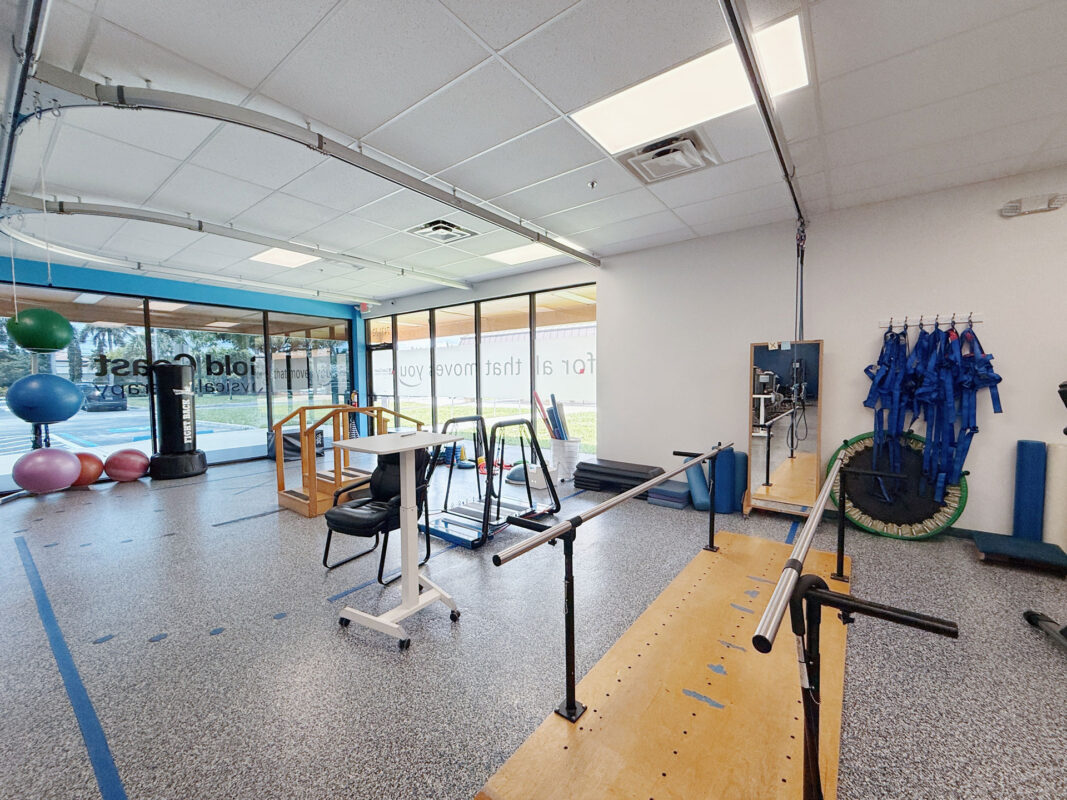
Our clinics are equipped with an overhead track and harness system that runs above the treatment floor. A patient is fitted into a supportive harness connected to that track, and from that moment on, falling is off the table. They can be challenged on uneven surfaces, on foam, with their eyes closed, with their head turning, while carrying something, while being gently perturbed, the same real-world conditions that cause falls at home and if their balance gives out, the system catches them.
What that unlocks is remarkable. Patients who arrive shuffling and white-knuckling a walker will, within a few sessions, try things they haven’t attempted in years. The fear releases first, and the physical progress follows fast behind it. We routinely see the most dramatic gains in the patients who were the most fearful walking in the door, precisely because we can finally push them the way their recovery requires.
Our Physical Therapists are Skilled in Balance Therapy
A harness in the hands of an untrained clinician is just a harness. What makes the difference is the team wearing the other end of the responsibility.
Every one of our therapists completes ongoing training in balance and vestibular assessment, fall-risk screening, and the specific progressions used with our overhead support system. Our staff train together across all of our Palm Beach County locations, so the standard of care doesn’t change depending on which of our clinics you walk into.
That investment is deliberate. Gold Coast Physical Therapy has been a locally owned physical therapy practice in Palm Beach County since 1998, treating the same families across generations. We aren’t guessing about what our community needs as it ages.
What to do this month
If you’ve had a fall in the past year, if you’ve caught yourself grabbing furniture as you cross a room, or if you’ve quietly started avoiding things you used to do and that’s worth a conversation. In Florida, you can see a physical therapist directly without a physician referral for an initial evaluation.
Come see the system for yourself. We’d rather show you than tell you.

Contact Gold Coast Physical Therapy today for your treatment plan.
The information provided in this article is intended for educational and informational purposes only and should not be considered medical advice, diagnosis, or treatment. Every individual and condition is unique, and treatment recommendations may vary. Always consult with a qualified healthcare provider or licensed physical therapist regarding any questions or concerns about your symptoms before beginning a new exercise or treatment program. If you experience severe pain, sudden weakness, loss of bladder or bowel control, or other emergency symptoms, seek immediate medical attention.